
The Hidden Threat Beneath Your Lawn: Why Excavation is No Longer the Only Option
You notice a slow drain, then a foul odor lingering in the yard, and suddenly you are facing a major underground plumbing crisis just as the late fall weather sets in. When exploring your options to fix a failing sewer line, trenchless pipe repair offers a modern, minimally invasive alternative to tearing up your property. For homeowners dealing with these severe underground issues, securing professional plumbing and sewer services from our team at Sewer Surgeons is the first step toward a permanent solution.
Historically, discovering a damaged sewer line brought an immediate sense of dread. The traditional method for replacing an underground pipe involved bringing heavy machinery onto your property, digging a massive trench from the house to the street, and displacing tons of soil. A pattern we see often when talking to homeowners is the fear of destroying driveways, tearing up hardscaping, and completely ruining the carefully curated yards of Chatham NJ properties with mature landscaping. Homeowners were left not only with a massive plumbing bill but also with the secondary costs of landscape restoration and concrete pouring.
Today, modern plumbing relies on advanced diagnostics rather than blind digging. Trenchless technology has revolutionized the industry by allowing our technicians to access, evaluate, and restore underground pipes through small, targeted access points. Instead of excavating the entire length of the pipe, this approach focuses on the exact location of the damage. By utilizing high-definition cameras and specialized materials, we can resolve complex underground threats while leaving the surface of your property largely untouched.
What is Trenchless Pipe Repair? Moving Beyond the Basics
At its core, trenchless technology is a specialized method of repairing or entirely replacing underground pipes with little to no excavation. While traditional methods require exposing the entire pipe to remove and replace it manually, trenchless systems operate from the inside out. This method effectively treats your home’s infrastructure with the same care and precision as minimally invasive surgery, prioritizing targeted restoration over widespread destruction.
The evolution from full-trench digging to trenchless applications was driven by the need to reduce collateral damage in residential areas. Decades ago, if a pipe collapsed under a concrete slab or a prized garden, the only option was a jackhammer or a backhoe. Now, by leveraging existing cleanouts or digging a single, small access pit, our Sewer Surgeons technicians can reach the problem area without disturbing the ground above. If you are understanding trenchless pipe lining for the first time, the most striking difference is the physical footprint of the work.
A traditional excavation crew requires heavy earth-moving equipment, dump trucks for displaced soil, and a massive safety perimeter. In contrast, when our trenchless repair crew arrives, we typically roll up in a specialized localized truck housing high-tech diagnostic gear, hydro-jetting equipment, and resin-curing tools. The entire operation is quieter, cleaner, and significantly faster.
The critical role of high-definition diagnostics:
- Precision mapping: Our cameras provide a real-time, illuminated view of the pipe’s interior, measuring the exact distance to root intrusions, cracks, or bellies.
- Material assessment: We can determine whether the existing pipe is clay, cast iron, or PVC, which dictates the type of repair material needed.
- Severity evaluation: Video inspections reveal whether a pipe is merely cracked and a candidate for lining, or completely crushed and requiring a different approach.

The “Surgical” Process: Step-by-Step Pipe Restoration
Because trenchless repair requires highly specialized equipment and precise chemical curing, it is exclusively performed by our trained professionals. The process is meticulous, functioning much like a medical procedure where diagnosis, preparation, and execution must be handled flawlessly. When executing structural pipe lining services, our crews follow a strict sequence of events to ensure the new pipe meets rigorous structural standards.
- Comprehensive diagnostic camera inspection: Before any work begins, our technicians send a high-definition crawler camera down the line. This step maps the entire sewer system, identifies all lateral connections, and pinpoints the exact locations of root intrusions, scale buildup, and structural fractures.
- Hydro-jetting and mechanical descaling: The host pipe must be perfectly clean for the new material to bond or pass through smoothly. We use high-pressure water jets and specialized mechanical descaling chains to obliterate tree roots, scour away decades of grease, and remove rust from cast iron pipes. This restores the pipe to its original inner diameter.
- The installation phase: Depending on the specific trenchless method chosen, our crew will either pull a resin-saturated felt liner into the cleaned pipe or drag a bursting head through the line to shatter the old pipe while pulling a new high-density polyethylene (HDPE) pipe into place.
- Curing and final video verification: If a liner is used, a calibration tube is inflated to press the resin tightly against the walls of the old pipe. It is then cured using ambient air, hot water, steam, or UV light until it hardens into a solid, seamless structural pipe. Finally, we perform a second camera inspection to verify the structural integrity and ensure all connections remain open and functional.
Why Professional Diagnostics Matter
Accurate measurement and material selection require specialized training and high-tech surgical tools. A homeowner cannot simply guess the depth, diameter, or structural condition of a buried sewer line. In our years of experience, we’ve found that misdiagnosing a pipe issue can lead to catastrophic failures. For instance, if a pipe has a severe “belly” (a sag in the line where water pools), simply lining it will not fix the slope issue; the new lined pipe will still sag and collect debris. Our professional technicians use advanced locators and inclinometers to map the slope and determine if the line is truly a candidate for trenchless restoration.
Cured-In-Place Pipe (CIPP) vs. Pipe Bursting: Which Method Fits Your Property?
When we recommend a trenchless solution to Chatham homeowners, we are generally referring to one of two primary methods: Cured-In-Place Pipe (CIPP) lining or Pipe Bursting. Both methods are highly effective and utilize durable materials designed to last up to 50 years, but they operate on entirely different mechanical principles. The right choice depends heavily on the extent of the existing pipe damage, the surrounding soil conditions, and the specific layout of your plumbing system.
Cured-In-Place Pipe (CIPP): This method involves creating a brand-new, epoxy-resin pipe directly inside the damaged host pipe. After thorough cleaning, a flexible, resin-saturated tube is inverted or pulled into the damaged line. Once inflated and cured, it forms a smooth, jointless pipe within a pipe. This is often the preferred method for fixing cracks, sealing joints, and sealing out root intrusions when the original pipe still retains its basic structural shape. It is also the foundation for trenchless pipe coating services, which can save weakened drain joints from full collapse.
Pipe Bursting: When evaluating a severely crushed or deformed line, we recommend pipe bursting over CIPP lining because a liner simply cannot pass through a collapsed opening. This method involves pulling a hardened steel bursting head through the old pipe. The conical head fractures the old clay, cast iron, or PVC pipe outward into the surrounding soil. Attached directly behind the bursting head is a brand-new, seamless HDPE pipe, which is pulled into the newly expanded cavity in a single continuous motion.
| Feature | Cured-In-Place Pipe (CIPP) Lining | Pipe Bursting |
|---|---|---|
| How it works | Creates a new resin pipe inside the existing pipe. | Fractures the old pipe outward while pulling in a new pipe. |
| Best used for | Cracks, minor root intrusion, weakened joints, scaling. | Severe collapses, undersized pipes, extensive structural failure. |
| Impact on pipe diameter | Slightly reduces the inner diameter (usually negligible). | Maintains or even increases the original pipe diameter. |
| Host pipe requirement | Host pipe must retain its general structural shape. | Host pipe can be severely compromised or crushed. |
| Soil displacement | Zero displacement; relies entirely on the existing cavity. | Pushes old pipe fragments outward into surrounding soil. |
The Fall Advantage: Fortifying Your Plumbing Before the Deep Freeze
Timing plays a crucial role in underground plumbing maintenance. Throughout the wet spring and hot summer months, tree roots grow aggressively in search of moisture and nutrients. Aging sewer lines, which constantly carry warm, nutrient-rich water, become prime targets. Microscopic roots force their way into tiny joint cracks, expanding over the summer until they create massive blockages and severely weaken the structural integrity of the pipe.
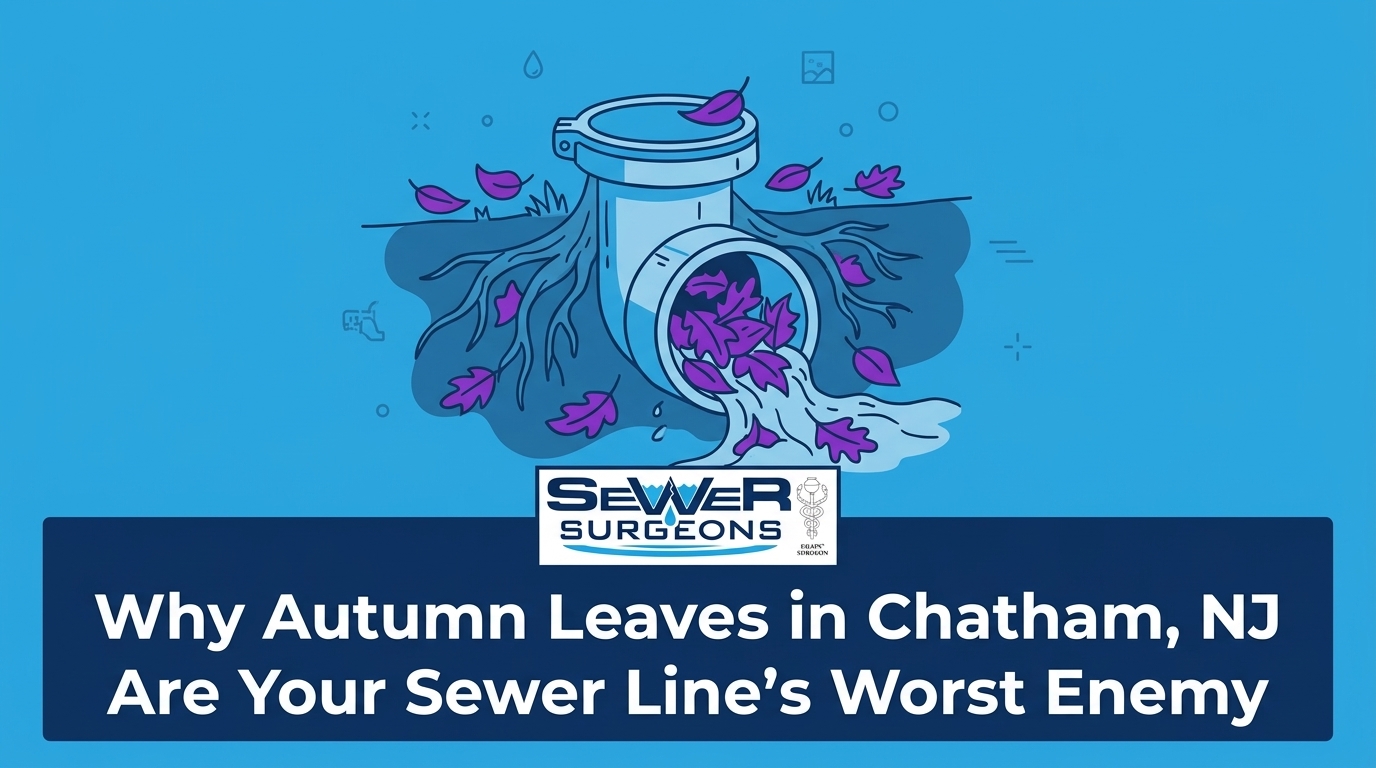
A pattern we see often during Chatham’s late fall is homeowners discovering this summer root damage just before the ground freezes. Leaving these weakened, root-infiltrated pipes untreated as temperatures drop poses a massive risk to your property. In northern New Jersey, the freeze-thaw cycles are notoriously hard on infrastructure. Our team typically sees the frost line in the Chatham area reach 36 inches deep. When the soil above and around a weakened pipe freezes solid, it expands and shifts. This immense hydrostatic pressure can easily crush a pipe that was already compromised by summer root damage.
This makes the late fall / pre-winter ground freeze the most critical window for addressing sewer vulnerabilities. If a pipe completely collapses in January, the frozen ground makes traditional excavation exponentially more difficult, disruptive, and time-consuming. Heavy machinery struggles to break through three feet of frozen earth, and restoring the landscape afterward is impossible until the spring thaw. By having our team utilize trenchless technology in the fall, you can permanently fortify your plumbing system, sealing out roots and reinforcing the pipe walls before the deep freeze sets in.
When is Traditional Excavation Still Necessary?
While trenchless technology is a remarkable advancement, it is important to understand that it is not a magic cure-all for every plumbing disaster. There are specific physical and structural limitations where the minimally invasive approach is simply not viable, and a traditional open-trench dig becomes mandatory.
A professional video inspection is the only way to determine the threshold between a trenchless candidate and a mandatory excavation. At Sewer Surgeons, our technicians look for specific disqualifying factors. If your system requires full sewer line replacement via traditional digging, it is usually due to one of the following conditions:
- Severe Pipe Bellies: If the ground beneath the pipe has washed away, causing the pipe to sag deeply, water and waste will pool in that “belly.” Trenchless lining follows the existing path, meaning it would simply create a smooth, newly lined belly. The only way to correct the physical slope for proper gravity flow is to excavate, re-grade the trench, and lay a new pipe.
- Complete Structural Collapse: If a pipe has flattened completely or massive sections have disintegrated, leaving nothing but dirt walls, there is no host pipe left to line, and a bursting head may not be able to navigate the collapsed channel safely.
- Improper Original Grading: If the original pipe was installed without the correct downward pitch toward the municipal sewer, it must be dug up and correctly angled.
- Intersecting Utility Lines: In rare cases, if a gas or water line was accidentally bored through the sewer line (a cross-bore), trenchless methods cannot be used until the intersecting utility is safely excavated and relocated.
Even when excavation is required, our modern plumbing methods aim to minimize the footprint. We use targeted spot-repairs when possible, excavating only the collapsed section rather than trenching the entire yard, ensuring the disruption is kept to the absolute minimum necessary for a safe, code-compliant repair.
Long-Term Benefits of the No-Dig Approach
For the Chatham homes we evaluate that qualify, the value proposition of trenchless repair extends far beyond simply avoiding a messy yard. It is a comprehensive upgrade to your property’s infrastructure that offers lasting peace of mind and significant secondary benefits.
- Preservation of landscaping and hardscaping: The most immediate benefit is the preservation of up to 90% of your existing property features. You avoid the heavy costs and logistical headaches of replacing poured concrete driveways, rebuilding stone retaining walls, or replanting mature trees and garden beds.
- Exceptional longevity: The materials used in both CIPP lining and pipe bursting are state-of-the-art. CIPP epoxy resins cure into a jointless, structurally independent pipe that is highly resistant to root intrusion, corrosion, and chemical degradation. Under normal conditions, these trenchless materials boast a lifespan of 50 years or more.
- Environmental protection: Traditional excavation displaces massive amounts of soil, disrupting local ecosystems and requiring old, contaminated pipe materials to be hauled away to landfills. Trenchless repair keeps the old pipe in the ground (either lined or fractured) and significantly reduces the carbon footprint associated with heavy earth-moving machinery.
- Rapid turnaround time: A traditional sewer replacement can leave a home without functional plumbing for several days, with landscape restoration taking weeks. A trenchless repair is often completed by our crews in a single day, allowing your household to return to normal operation with minimal downtime.
Frequently Asked Questions About Trenchless Pipe Repair
How long does trenchless pipe repair last?
Trenchless pipe repair is designed to be a permanent, long-term solution, typically lasting 50 years or more under normal conditions. The materials we use, such as specialized epoxy resins for lining and high-density polyethylene (HDPE) for bursting, are highly resistant to corrosion, shifting soil, and tree root intrusion. Because the new pipe is seamless, it eliminates the weak joints where traditional pipes usually fail first.
What are the disadvantages of trenchless sewer repair?
The primary limitation is that it cannot fix underlying slope or grading issues. If your sewer line has a severe “belly” or sag that causes wastewater to pool, a trenchless liner will simply conform to that incorrect slope. Additionally, if the original pipe is completely collapsed or crushed flat, trenchless equipment cannot pass through, making traditional excavation the only viable option.
Is trenchless sewer repair worth it?
For most homeowners, trenchless repair provides immense value by eliminating the secondary costs of property restoration. When you factor in the expense of repouring a concrete driveway, replacing a patio, or hiring landscapers to rebuild a torn-up yard, the minimally invasive approach often proves to be the most efficient and property-preserving choice. The 50-year lifespan of the materials also ensures it is a one-time, permanent upgrade.
Can all pipes be fixed without digging?
No, not all pipes are candidates for the no-dig approach. While trenchless technology can resolve cracks, minor root intrusions, and weakened joints, pipes that have completely collapsed, lost their structural integrity, or suffer from severe back-pitching must be physically excavated. A professional video inspection by our technicians is always required to determine if a specific pipe qualifies for trenchless restoration.
Will trenchless repair damage my existing landscaping?
Trenchless repair is specifically designed to preserve up to 90% of your existing landscaping and hardscaping. Our technicians typically only need one or two small access pits—often utilizing existing cleanouts—to perform the entire restoration. This means your mature trees, garden beds, and custom driveways remain entirely intact and undisturbed during the process.
Why is fall the best time for trenchless sewer inspections in New Jersey?
Fall provides the optimal window to assess and repair summer root damage before the harsh winter weather arrives. Once the New Jersey frost line freezes solid (often reaching 36 inches deep), weakened pipes are subjected to immense soil pressure, increasing the risk of a sudden collapse. Completing trenchless repairs in the fall secures the plumbing system before frozen ground makes any kind of exterior plumbing work significantly more difficult and disruptive.
Protect Your Property with Minimally Invasive Sewer Solutions
Fixing a compromised sewer line no longer means sacrificing your driveway, your patio, or your carefully maintained yard. Trenchless technology has transformed a historically destructive process into a precise, surgical intervention that restores your plumbing from the inside out. By leveraging high-definition diagnostics and advanced curing materials, you can secure a seamless, root-proof pipe that will serve your home for decades.
With the harsh winter weather approaching, now is the time to act. Do not wait for summer root damage to turn into a mid-winter pipe collapse under frozen soil. We encourage you to have the Sewer Surgeons team professionally inspect your underground pipes before the deep freeze sets in. Understanding the exact condition of your system allows you to make informed decisions and explore minimally invasive structural lining options to protect your property for the long term.