The Dilemma of Clearing Blockages in Aging Plumbing
Your sinks are draining sluggishly, the toilets are gurgling, and you know there is a stubborn blockage deep within your main sewer line. The mechanics of hydro jetting cast iron pipes without causing damage is the exact solution you need, but the idea of shooting highly pressurized water into decades-old plumbing can feel incredibly risky. For many homeowners, the immediate fear is that the intense water pressure will shatter fragile, aging pipes, turning a routine drain cleaning into a catastrophic plumbing failure.
In our years serving the community, our team at Sewer Surgeons hears this anxiety constantly. This fear creates a difficult decision point. Do you settle for temporary fixes, like running a mechanical snake down the line, knowing it will only punch a small hole through the blockage and leave the bulk of the debris behind? Or do you authorize hydro jetting, hoping the technicians know how to handle delicate infrastructure? For owners of Chatham NJ historic homes, this hesitation is incredibly common, as the original plumbing systems have often been in the ground for generations.
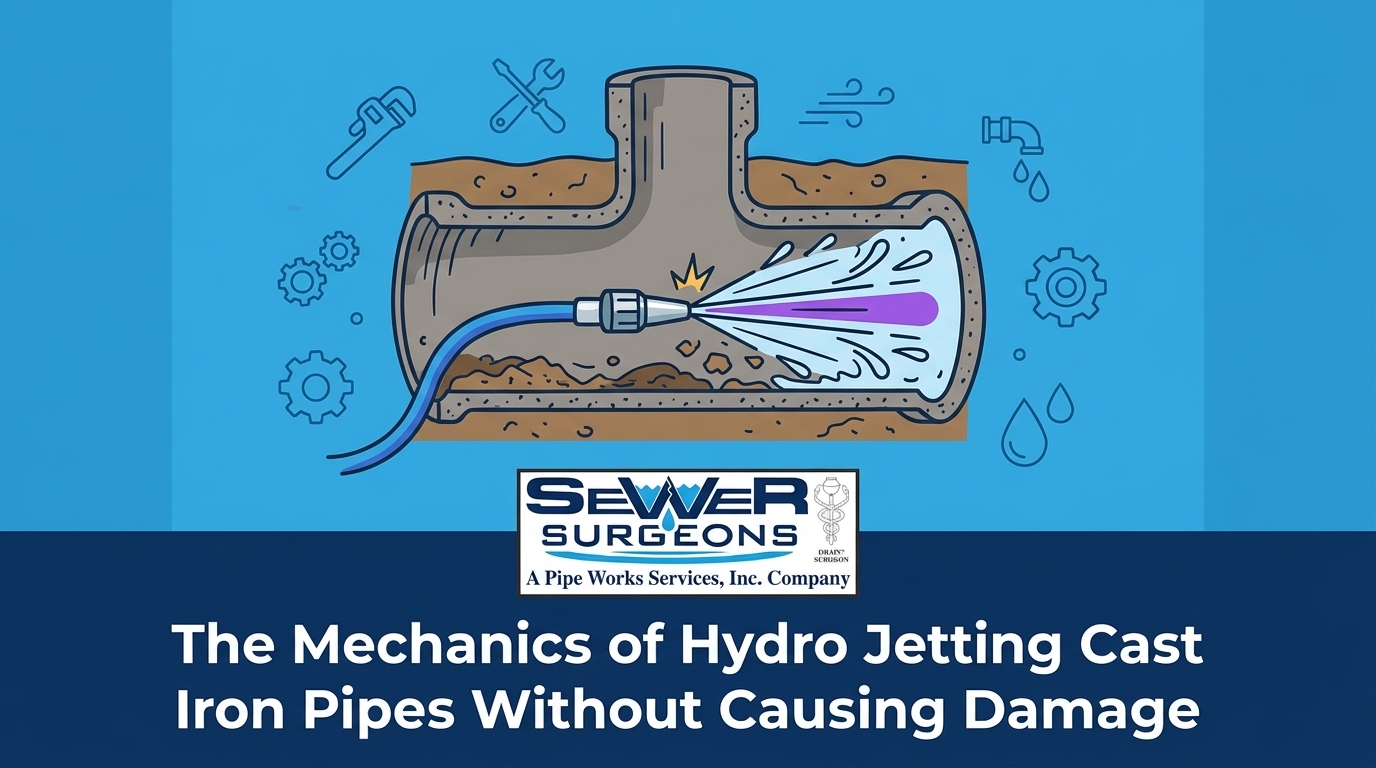
The reality we demonstrate to our clients every day is that professional hydro jetting does not rely on brute force. It is a highly calculated process governed by fluid dynamics, specialized equipment, and careful mechanical adjustments. When executed correctly by our trained technicians, it is entirely possible to clear out severe blockages, heavy scale, and dense root masses without compromising the structural integrity of the pipe. Understanding how this process works—and the specific safeguards professionals use—can help you make an informed decision about maintaining your home’s aging wastewater system.
Why Aging Cast Iron Systems Become Uniquely Vulnerable
To understand why specialized cleaning techniques are necessary, we first have to look at the material itself. Cast iron was the gold standard for residential sewer lines for most of the 20th century, prized for its durability and excellent sound-deadening properties. However, these systems were generally designed with a functional lifespan of 50 to 100 years. If your home was built before the 1980s, our team typically sees that your plumbing is likely reaching a critical aging milestone where the metal behaves very differently than it did when it was newly installed.
The Internal Chemistry of Pipe Degradation
Over decades of constant use, cast iron undergoes a chemical and physical transformation. As wastewater flows through the line, hydrogen sulfide gases naturally form. When these gases mix with moisture on the upper walls of the pipe, they create a mild sulfuric acid that slowly eats away at the metal. Simultaneously, a process called tuberculation occurs. This is where rust and hard water minerals build up on the interior walls, creating jagged, uneven scaling that catches debris and narrows the pipe’s diameter. Over time, the pipe walls thin out, particularly along the bottom channel where water constantly flows, making the metal highly fragile and susceptible to cracking under stress.
Environmental Pressures and Climate Factors
The vulnerability of aging cast iron is not just an internal issue; external environmental factors play a massive role. In regions like ours that experience distinct seasonal changes, the ground is rarely static. Freeze-thaw cycles cause significant ground shifting throughout the year. As the soil freezes and expands, then thaws and contracts, it exerts immense pressure on the rigid hub-and-spigot joints of older cast iron pipes. This shifting makes the already aged metal more brittle and prone to micro-fractures.
These micro-fractures act as an open invitation to the surrounding landscape. Tree roots are incredibly opportunistic, and as the weather cools, trees aggressively seek out moisture and nutrients to sustain themselves before winter dormancy. They are naturally drawn to the warm, nutrient-rich vapor escaping from compromised pipe joints. This combination makes the system highly susceptible to a mid-fall root intrusion and pre-winter plumbing inspection discoveries. A pattern we see often during our October service calls is that once roots breach the pipe, they multiply rapidly, forming dense, net-like blockages that trap solid waste and cause severe backups.
The Crucial First Step: Comprehensive Video Diagnostics
Because older cast iron is so structurally complex, our professionals never apply water pressure blindly. The absolute most important phase of the hydro jetting process happens before a single drop of water is introduced into the line. A comprehensive video camera inspection is mandatory for older plumbing, serving as our primary safeguard against accidental damage.
Professionals use high-resolution, waterproof cameras attached to flexible fiber-optic push rods to navigate the entire length of the sewer line. This diagnostic phase allows technicians to assess the exact condition of the pipe walls and determine if the system is a safe candidate for high-pressure cleaning. The diagnostic process typically follows these strict criteria:
- Verifying Structural Integrity: The technician looks for signs of severe “channeling” (where the bottom of the pipe has completely rotted away) or longitudinal cracks. If the pipe has already collapsed or is missing significant sections of its floor, hydro jetting is contraindicated, and structural repairs are required.
- Identifying the Blockage Type: The camera reveals exactly what is causing the backup. Is it a dense web of tree roots, a buildup of solidified grease, heavy tuberculation (rust scale), or a combination of all three? Knowing the enemy dictates the equipment setup.
- Mapping the Root Zones: If roots are present, the technician notes their exact location, density, and how they have entered the pipe. This tells the operator exactly where to focus their efforts and what type of cutting power will be required.
When our technicians perform these evaluations for owners of Chatham NJ historic homes, this camera inspection is often the first time they see the true interior condition of their plumbing. By physically verifying that the pipe walls are intact enough to withstand cleaning, professionals eliminate the guesswork and ensure that hydro jetting will solve the problem rather than exacerbate it.

Calibrating Water Pressure to Protect Fragile Walls
The term “high-pressure water jetting” sounds inherently aggressive, but the true mechanics of the process revolve around precise calibration. Standard hydro jetting for commercial applications or modern PVC piping can easily exceed 4,000 PSI (Pounds per Square Inch). While that level of force is excellent for clearing industrial grease traps, applying 4,000 PSI to an 80-year-old cast iron pipe is a recipe for disaster.
The Physics of PSI vs. GPM
To protect fragile walls, professionals manipulate two distinct variables: PSI (pressure) and GPM (Gallons Per Minute, or volume). PSI provides the cutting force necessary to slice through roots and dislodge hard scale. GPM provides the flushing power necessary to carry that heavy debris down the line and into the municipal sewer.
When dealing with aging infrastructure, the goal is to lower the PSI to a safe threshold while maximizing the GPM. Instead of blasting the pipe with a concentrated, high-pressure needle of water, the technician uses a higher volume of water at a lower pressure—often calibrating the machine down to 1,500 or 2,000 PSI. This lower pressure is strong enough to cleanly sever tree roots and wash away loose rust, but it falls well below the threshold that would cause intact cast iron to fracture or split.
Monitoring the Process
At Sewer Surgeons, our specific pressure-adjustment process is tailored for historic homes, ensuring safe root and blockage removal without compromising aged cast iron. Our technicians monitor the pressure gauges continuously throughout the service. They start at the lowest effective pressure setting and only incrementally increase it if a particularly dense root mass refuses to clear. This patient, methodical approach ensures that the pipe is never subjected to unnecessary stress. Protecting the plumbing in Chatham NJ historic homes requires this exact calibration; we find it is the difference between a successfully restored sewer line and a costly excavation.
Specialized Nozzle Technology for Safe Root Removal
Calibrating the water pressure is only half of the mechanical equation. The other critical component is the nozzle attached to the end of the hydro jetting hose. The nozzle dictates how the water is dispersed, and choosing the wrong one can cause significant damage to older pipes, regardless of the pressure setting.
Standard penetrating nozzles are designed to blast a concentrated stream of water straight ahead to punch through soft blockages like grease or paper. However, firing a concentrated stream directly at a brittle cast iron wall or a compromised joint can cause immediate scoring or blowouts. To safely navigate older systems, professionals utilize specialized, multi-directional nozzles.
- Rotating Root-Cutting Nozzles: These nozzles feature a rotating head that spins rapidly as water flows through it. Instead of a single forward blast, they distribute water in a 360-degree arc, creating a high-speed, liquid blade. This lateral water distribution slices through roots cleanly and evenly without focusing destructive force on any single point of the pipe wall.
- Descaling Nozzles: Cast iron pipes often suffer from heavy tuberculation (rust buildup). Descaling nozzles use a combination of forward and rear-facing jets that operate at specific angles to gently knock loose the jagged rust scale. The rear-facing jets also provide the thrust needed to pull the hose down the line while simultaneously flushing the heavy rust flakes backward out of the pipe.
- Low-Impact Flounder Nozzles: Designed for pipes with heavy debris lying on the bottom channel, these nozzles direct water downward and backward, sweeping the floor of the pipe without blasting the more fragile upper walls.
The correct nozzle choice acts as a precision tool rather than a blunt instrument. Knowing when hydro jetting is ideal for older pipes often comes down to matching the exact nozzle configuration to the specific type of blockage identified during the camera inspection. Based on the seasonal trends our team handles, when dealing with a mid-fall root intrusion and pre-winter plumbing inspection, utilizing a rotating nozzle allows our technicians to clear the entire diameter of the pipe, gently removing rust buildup alongside the roots without scoring the aged metal.
Comparing Jetting to Mechanical Snaking in Older Systems
When faced with a severe backup, we notice many homeowners initially lean toward mechanical snaking (using a plumbing auger) because it seems less intimidating than pressurized water. However, when evaluating the long-term health of an aging sewer system, a pattern we see often is that relying on a mechanical snake can carry more physical risks and offer fewer benefits than calibrated hydro jetting.
The Limitations of the Auger
A mechanical snake uses a flexible metal cable with a cutting blade attached to the end. The technician feeds the cable down the line and a motor spins the blade to chop up the blockage. While this is highly effective for soft clogs in indoor drains, it has severe limitations when dealing with dense root intrusions in main sewer lines. The snake typically only punches a hole through the center of the root mass—a hole exactly the size of the blade. It leaves the vast majority of the roots attached to the pipe walls, meaning the blockage will quickly regrow and cause another backup.
Physical Risks to Brittle Pipes
Furthermore, mechanical snaking relies on violent friction. As the heavy metal cable spins, it slaps and scrapes against the interior walls of the pipe. In a new PVC pipe, this is fine. In an 80-year-old cast iron pipe suffering from tuberculation and thinning walls, the aggressive scraping of a metal blade can easily catch on a jagged piece of rust, torque the pipe, and cause a crack or joint separation.
Properly calibrated hydro jetting, by contrast, uses water as the cutting medium. There are no metal blades scraping against the fragile walls. It cleans the entire 360-degree diameter of the pipe, removing the roots down to the joint and washing away the rust scale that causes future snags. For Chatham NJ historic homes, we recommend calibrated jetting over repetitive snaking because it is a safer and far more comprehensive long-term solution.
| Feature | Mechanical Snaking (Auger) | Calibrated Hydro Jetting |
|---|---|---|
| Root Removal Efficiency | Low; punches a hole through the center, leaving roots on walls. | High; cleans the entire 360-degree diameter of the pipe. |
| Impact on Pipe Walls | High friction; metal cables and blades scrape against brittle cast iron. | Low friction; uses calibrated water pressure and multi-directional nozzles. |
| Scale & Rust Removal | Ineffective; cannot remove tuberculation or hard scale buildup. | Highly effective; gently descales rust and washes it out of the system. |
| Long-Term Effectiveness | Temporary; roots regrow quickly, requiring frequent repeat service. | Long-lasting; thoroughly restores the pipe’s internal diameter. |
Frequently Asked Questions About Servicing Old Pipes
Can hydro jetting damage cast iron pipes?
Yes, if performed incorrectly by an untrained operator using uncalibrated equipment, hydro jetting can damage cast iron pipes. However, when performed by a professional who first conducts a video inspection and lowers the PSI to safe thresholds, it is an incredibly safe and effective cleaning method. The risk comes from blind application of maximum pressure, not from the technology itself.
How do plumbers adjust hydro jetting for old pipes?
Plumbers adjust the process by manipulating the balance between pressure (PSI) and volume (GPM). For older, fragile pipes, they significantly lower the PSI to prevent cutting into the metal while maintaining a high GPM to ensure heavy debris is still flushed away. They also swap out aggressive forward-penetrating nozzles for multi-directional, rotating nozzles that distribute the water evenly.
What is the safest way to remove roots from cast iron sewer lines?
The safest way to remove roots from cast iron is a multi-step professional process. It begins with a video camera inspection to ensure the pipe has not already collapsed. Once structural integrity is confirmed, the technician uses calibrated, low-pressure hydro jetting with a specialized root-cutting nozzle to cleanly slice the roots away from the joints without scraping the pipe walls with metal blades.
What PSI is safe for cast iron?
There is no single universal number, as the safe PSI depends entirely on the current condition of the specific pipe being serviced. However, professionals typically calibrate their machines down to between 1,500 and 2,000 PSI for aging cast iron. This is significantly lower than the 4,000+ PSI used for commercial lines, providing enough force to cut roots without stressing the metal.
Does hydro jetting damage old pipes?
Hydro jetting does not inherently damage old pipes; it damages structurally compromised pipes. If a pipe is old but still structurally sound, calibrated jetting is perfectly safe. If a pipe is old and actively crumbling, collapsing, or suffering from severe channel rot, the pressure can cause it to fail completely. This is why the pre-jetting camera inspection is an absolute requirement.
How often should a historic home’s sewer line be inspected for root intrusion?
Historic homes with original cast iron plumbing and mature landscaping should have their sewer lines inspected by a professional annually. Scheduling a mid-fall root intrusion and pre-winter plumbing inspection is highly recommended, as tree roots grow most aggressively in the fall as they seek out moisture before the ground freezes for the winter.
Securing Your Historic Plumbing for the Season Ahead
The age of your plumbing does not automatically disqualify your home from receiving thorough, effective drain cleaning. While it is natural to fear that high-pressure water might destroy your aging cast iron, understanding the mechanics behind professional hydro jetting should provide peace of mind. By relying on mandatory camera diagnostics, carefully calibrating the water pressure, and utilizing specialized multi-directional nozzles, technicians can safely clear out severe blockages without putting undue stress on fragile pipe walls.
As the weather cools and tree roots become more aggressive, the team at Sewer Surgeons typically sees the risk of a severe sewer backup increase dramatically. Do not wait for a mid-fall root intrusion and pre-winter plumbing inspection to turn into an emergency raw sewage backup in your basement. If your drains are slowing down or you suspect roots have breached your older system, seek a professional evaluation today to safely restore your home’s wastewater flow before winter weather complicates the situation.